


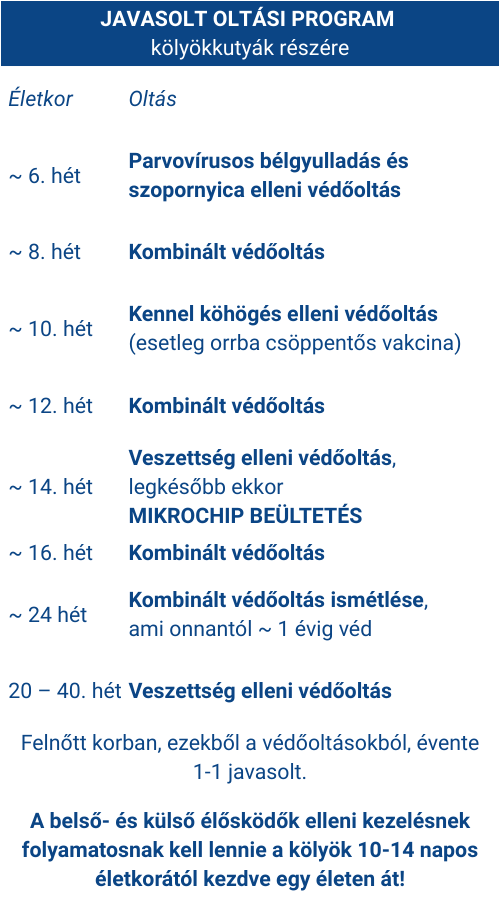
In Hungary, rabies vaccination is mandatory for dogs.
The first vaccination must be administered at around 3 months of age, followed by a second vaccination within six months, during a veterinary examination.
(This means that dogs must receive two rabies vaccinations by 9 months of age.)
After this, the vaccination must be repeated annually throughout the animal’s entire life.
Although modern vaccines may provide immunity for up to three years, legislation correctly requires annual revaccination. This is especially justified, as regions of the former Yugoslavia, as well as Romania and Ukraine, still pose a significant rabies risk.
Effective protection is available for cats against the following diseases:
feline upper respiratory viruses,
panleukopenia virus,
chlamydia,
FeLV,
FIV,
FIP.
Deworming is just as important for cats as it is for dogs — starting from 3 weeks of age, and then regularly throughout their entire lives.
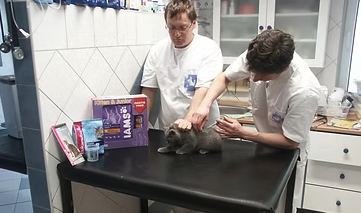

Annual administration of modern dog and cat vaccines can spare owners a great deal of worry and inconvenience.
In dogs, excellent long-term protection can be achieved against:
parvoviral enteritis,
canine distemper,
infectious hepatitis.
Slightly shorter-lasting protection is provided against leptospirosis and kennel cough.
Vaccines administered at the correct time and with proper boosters provide the most effective protection — but only if the immune system is healthy.

Dogs and cats living with humans as companion animals enjoy far greater safety than animals in the wild — though their challenges are simply different.
They do not need to struggle daily for food or shelter, yet their reproductive cycles remain unchanged. If given the opportunity, they will reproduce — and if this happens uncontrolled, it leads to serious consequences.
One of the most important aspects of responsible pet ownership is reducing the number of stray animals, and the cornerstone of this effort is preventing uncontrolled reproduction.
Neutering plays a key role in this.
Neutering is the safest, healthiest, and lowest-risk solution, ideally performed around puberty.
Male dog and cat neutering is often surrounded by emotional misconceptions — especially among men — but such humanized thinking must be set aside in the animal’s best interest.
Maintaining sexual frustration without the possibility of mating is harmful.
Allowing uncontrolled breeding is equally irresponsible.
Every owner should consider what would happen if all offspring produced by their pet were brought back to their own home.
This is no exaggeration — uncontrolled breeding is how streets become filled with stray animals, posing a serious burden to both animals and society.
There are already countless animals in shelters waiting for adoption — we should help them, not increase their numbers.
Neutering females prevents overpopulation within a household.
Neutering a single male dog or cat can prevent the birth of numerous unwanted offspring in a very short time.
In young, healthy male animals, neutering is considered a relatively simple surgery. However, because anesthesia is required, complications are always possible.
This is why it is essential to choose a clinic that applies the highest professional standards, appropriate anesthesia, and proper surgical techniques.
In young, healthy females, the procedure is a moderately complex abdominal surgery. Surgical expertise is crucial to avoid early or late complications, such as urinary incontinence, which may appear years later.
In older, ill, or congenitally affected animals (e.g. cryptorchid males), surgery becomes more difficult and anesthesia risk increases.
If the animal is already suffering from conditions such as pyometra or reproductive tumors, the procedure presents an even greater challenge.

Therefore, youth and good health represent the optimal time for neutering. This significantly reduces the risk of many serious diseases, including:
pyometra, which affects 40–50% of elderly, non-neutered females — risk is reduced to nearly zero,
mammary tumors, whose incidence drops to about 1% if neutering is performed around puberty.
Combined with reduced stress during heat cycles and calmer behavior toward other animals, this is truly a major benefit for both pet and owner.
“My pet will gain weight.”
Energy requirements do decrease by 25–30%, so dietary adjustment is necessary — but pets do not open the refrigerator. Obesity is almost always the owner’s responsibility.
“Behavior will change.”
False. Most animals remain playful and balanced. Reduced activity usually results from obesity, not neutering.
“Hormonal disorders will occur.”
This is very rare and usually treatable. Complications are far more likely if surgery is performed with improper technique — emphasizing the importance of choosing an experienced professional.
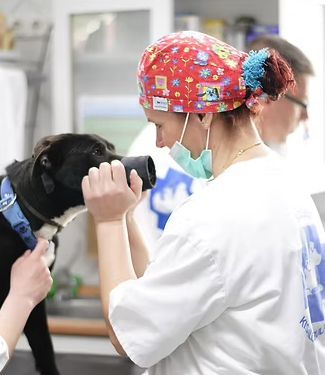
Few owners realize that their pet’s unpleasant breath can pose a serious health risk — even to the family.
Dental tartar forms from plaque left on the teeth and gums, progressing from mild gum redness to severe inflammation, bone destruction, and tooth loss.
This chronic inflammation acts as a constant source of infection, overburdening the immune system and potentially causing heart, kidney, pancreatic, or neurological diseases. In severe cases, bacteria may enter the bloodstream and lead to sepsis.
Bacteria exhaled by pets can be inhaled by family members, increasing the risk of allergies, recurrent infections, and chronic illnesses.
Untreated dental disease is therefore not only a cosmetic issue but a serious health concern for both pets and humans.

Dirofilaria immitis and Dirofilaria repens are mosquito-borne parasites reaching 20–40 cm in length, living for up to 7–8 years in the pulmonary arteries or subcutaneous tissues. These parasites are zoonotic, meaning they can also infect humans.
Dirofilaria immitis and Dirofilaria repens are mosquito-borne parasites reaching 20–40 cm in length, living for up to 7–8 years in the pulmonary arteries or subcutaneous tissues. These parasites are zoonotic, meaning they can also infect humans.
Heartworms damage the pulmonary arteries and heart lining, leading to heart failure.
Skin worms migrate through connective tissues and may reach joints or even the eyeball.
Adult worms release microfilariae into the bloodstream, which mosquitoes transmit to new hosts. Larvae mature into adult worms within 6–8 months.
Only dual protection is effective:
mosquito repellence,
prevention of larval development.
Reliable medications must be administered every 28 days.
Based on thousands of tests, infection rates in our region exceed 10%, which is extremely high.
Only dual protection is effective:
mosquito repellence,
prevention of larval development.
Reliable medications must be administered every 28 days.
Based on thousands of tests, infection rates in our region exceed 10%, which is extremely high.
Treatment is complex, costly, and risky, and should only be performed in well-prepared veterinary facilities with full owner cooperation.
Over the past ~12 years, we have successfully treated and cleared 600–700 dogs.
Prevention is therefore crucial — heartworm disease threatens both pets and humans.

This website was created within the framework of, and with the support of, the Demján Sándor Program.
Opening hours: Monday–Friday, 11:00 AM–5:00 PM
Dr. Antal Rengei: 06-20-9217-737
Dr. János Szalay: 06-30-9532-698
Dr. László Perényi: 06-30-1956-960
Dr. Richárd Komáromi: 06-62-543-855
This website was created within the framework of, and with the support of, the Demján Sándor Program.
© 2025 Kisállat-Ambulancia Kft. All rights reserved.